The Meeting Minute Before the Meeting Minutes
Meeting minutes begin before anyone sits down: prepare a decision-focused page that helps preserve what was agreed, who will act and what remains open.
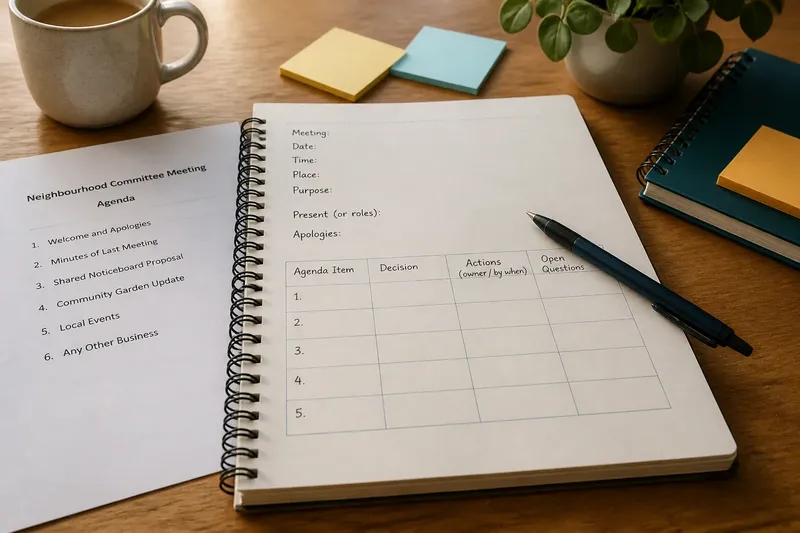
Before a neighbourhood committee meeting begins, someone lays a blank page beside the agenda and writes down the date, the meeting’s purpose and the decisions likely to need recording. That small preparation is the meeting minute before the meeting minutes: a way to keep the official record focused on what the group decides, rather than everything people say.
Meeting minutes are not a transcript. A transcript attempts to capture speech; minutes preserve the business of the meeting, including decisions, assigned actions and unresolved questions. Treating them as a record of outcomes makes them easier to use later and less likely to turn disagreement into a misleading account of who said what.
Prepare a decision page before the meeting
In the days before a meeting, read the agenda and mark the items that call for a decision. A routine update may need only a brief note that it was received. A proposal to change a shared facility’s opening arrangements, by contrast, may require a clear record of the question considered and the decision reached.
Set up a page or document with space for:
- The meeting name, date and place, plus the names or roles of those present and any apologies, where the group normally records them.
- Each agenda item that could result in a decision.
- The decision itself, with its wording as precise as the group can make it.
- Any action agreed, the person or role responsible and the point at which progress should be reported.
- Questions left open, including what information or discussion is still needed.
- Any declared interest or procedural detail the group’s usual record requires.
Leave room beside each likely decision. Do not draft an outcome before the discussion; a prepared page is a prompt, not a prediction. If the agenda changes, add the new item and mark where it belongs.
Check the group’s rules, any applicable local requirements and the meeting chair’s instructions for details the record must include.
During discussion, listen for the decision
As people speak, note only what helps establish the path to an outcome. A short neutral phrase may explain why a choice was made, especially if the decision would be unclear without it. There is usually no need to attribute every argument to a named person.
Pay attention to the chair’s wording when discussion moves towards a decision. Is the group approving a proposal, asking for a revision, postponing the matter or taking no action? These are different outcomes. If the wording is vague, ask the chair to state what the meeting has agreed before moving on.
Say you are recording a neighbourhood group’s decision about a shared noticeboard. Members discuss location, maintenance and access, then agree to ask the library manager whether a proposed wall can be used before choosing a site. The minutes should record the request, who will make it and that the location remains undecided. They should not imply that the group approved the wall or reproduce the whole debate.
If discussion produces no decision, record that plainly. “No decision was reached; the item will return after members review the options” tells a future reader more than a vague note that the subject was discussed.
Separate decisions, actions and open questions
These three kinds of note answer different questions. A decision says what the group agreed. An action says who will do something next. An open question says what remains unsettled. Keep them visibly distinct, even if your organisation uses a simple document rather than formal headings.
For an action, record an owner rather than writing “someone will contact the council”. If the group has not assigned a person, note that the action still needs an owner. Do not turn a suggestion made during discussion into an agreed task unless the meeting actually accepts it.
Use plain language and avoid loaded descriptions. “Members raised concerns about access” is more useful than a judgement about whether a concern was reasonable. If the group needs to preserve a formal motion or vote result, record it accurately according to its established procedure.
Review the draft while the meeting is fresh
After the meeting, turn shorthand into complete, readable notes while the sequence of decisions is still clear. Check each agenda item against the page you prepared. Confirm that decisions have not been confused with proposals, and that an action has not lost its owner or purpose.
Where a phrase is unclear, ask the chair or the person responsible for minutes to confirm what the meeting agreed. Do not fill a gap by guessing. If there is uncertainty about the outcome, make that visible and seek clarification through the group’s normal process.
Imagine you have written “follow up with the library” but cannot remember whether the committee asked for permission, availability or a cost estimate. Rather than choosing one, check with the chair and correct the draft before it is circulated. The observable result should be a note that tells the assigned person what to ask and lets readers understand the committee’s next step.
Keep the record useful after approval
Once the group has approved its minutes through its usual process, store them where members can find them and use them to track unfinished actions. At the next meeting, compare the action notes with what has been completed, what is still under way and what needs a new decision. This follow-up makes the record part of the group’s working memory, not just an account filed away.
Access and retention should suit the organisation’s rules and the sensitivity of the material. A public record may need to be available to residents, while personal details or confidential matters may require careful handling. Keep any restricted material separate where the group’s procedures call for it.
A useful test is whether someone who missed the meeting can tell what changed, what happens next and what remains unresolved without being handed a transcript. Meeting minutes serve the public best when they make those outcomes clear. Before the next agenda is printed, carry unresolved actions forward so the record leads naturally into the next decision.
What do readers need from meeting minutes?
Are meeting minutes meant to record every comment?
No. Minutes usually capture decisions, actions and enough context to make them understandable, rather than a word-for-word account. Follow the group’s agreed procedure for any formal record it requires.
What should be recorded when a proposal is postponed?
State that no final decision was made and note the agreed next step, such as returning the item after further information is gathered. Include who is responsible for that step if the group assigned someone.
How should disagreement appear in the record?
Use a concise, neutral description if the disagreement explains the decision or the lack of one. Record a formal vote or motion accurately when the group’s procedure calls for it, without adding personal commentary.
What if nobody agreed to take an action?
Do not invent an owner or present a suggestion as an assignment. Record that responsibility remains unassigned and leave it for the group to resolve at the appropriate point.