Town Hall, Library or Park: Choosing a Place for a Community Gathering
Choosing a place for a community gathering? Compare town halls, libraries and parks to match your event format, access needs and arrival arrangements.
At a residents’ meeting, one person arrives with a pushchair while another pauses outside, unsure which door to use. Choosing a place for a community gathering affects whether both can join in. A town hall, library or park each supports a different kind of event, so start with what people will do and what they need to take part.
Match the venue to the gathering
Write down the planned activities before contacting a venue. Will people listen to a speaker, discuss a neighbourhood issue, bring children, look at displays or move between small groups? Entrances, noise, layout and the building’s ordinary use all affect how an event feels.
Consider who should be able to attend. Check step-free access, public transport, toilets, seating and shelter. Ask whether someone can enter without already knowing the group, and confirm any venue conditions that might affect the programme.
Start with the activity and the people, not the room’s appearance.
A town hall gives a structured meeting a clear focus
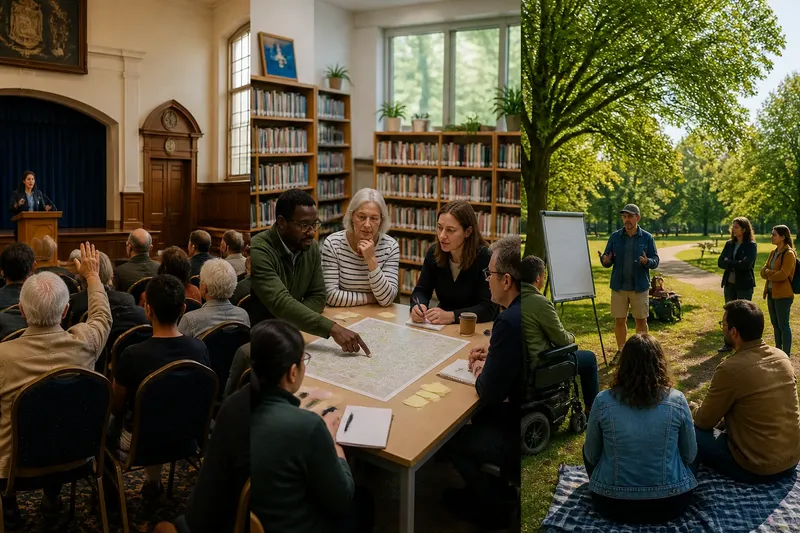
A town hall can suit a residents’ forum, public discussion or presentation followed by questions. The setting signals a civic purpose, and a speaker’s position can help an audience follow a structured session.
That formality may also make an informal exchange feel stiff. Rows of chairs direct attention towards the front, and an official-looking entrance can leave newcomers unsure where to sit or when to speak. Ask whether the room can be arranged in a circle or small clusters.
Confirm what the booking includes. You may need a welcome point, microphone, screen or separate area for private conversations. Ask whether another group will use nearby rooms, and check how visitors can find the correct entrance.
Choose a town hall when the gathering needs a recognisable civic setting and a shared focus. Keep the seating as open as the format allows.
A library supports quieter, mixed-purpose gatherings
A library can suit a reading group, local history discussion, advice session or small public workshop. Tables and chairs support conversation, while books or local information can give a subject a natural context.
Libraries have their own rhythm. Quiet areas, study spaces and other visitors may limit loud discussion, amplified sound or movement. Ask which rooms are available, how they are separated from public areas and whether the library can share event information through its usual channels.
Consider how the group will share the space. A compact room may work for a focused conversation but feel cramped if attendees need to move around displays. A door can help contain sound, but make sure the entrance is easy to spot and welcoming to someone arriving alone.
Choose a library when the event benefits from a calm indoor setting and a connection to learning, reading or local information. State the likely noise and room needs before booking.
A park suits movement and open-air participation
A park works well for walking, informal conversation, outdoor activity or a gathering centred on shared public space. People can arrive and leave without entering a meeting room, and passers-by may notice the activity and decide to approach.
Open air brings less control. Wind, rain, uneven ground and competing noise can interrupt a speaker or make printed materials difficult to use. Check for shade, shelter, places to sit and a clear meeting point. If everyone needs to hear the same announcement, an exposed lawn may be a poor fit.
Plan around the park’s ordinary use. Keep paths passable and avoid taking over an area others need. Ask the local authority or park manager about permissions and conditions, especially if the event includes food, equipment or amplified sound.
Choose a park when people should be able to move and mingle. Have a sheltered alternative if poor weather would undermine the event.
Check access before choosing the atmosphere
A welcoming mood cannot make up for a venue that people cannot reach or use. Consider the whole journey: getting there, finding the entrance, entering the room and taking part once inside. A central address may still be difficult if the route is confusing or there is nowhere to rest.
- Entrance: Check whether the correct door is easy to identify. If it is clear, include it in the arrival note; if not, ask about signs or choose a simpler meeting point.
- Routes: Check whether the path from the entrance to seating and activities is straightforward. If it is, plan the layout along it; if not, ask about another room or adapt the activity.
- Facilities: Check whether toilets, seating and a quiet space are available and suitable. If they meet attendees’ needs, describe them accurately; if not, ask the venue about alternatives before inviting people.
- Travel: Check whether likely attendees can reach the venue using local transport or walking routes. If they can, give clear directions; if not, consider a more accessible location or a different event format.
- Participation: Check whether someone can listen, contribute or step away without disrupting the gathering. If they can, keep those options in the format; if not, adjust the seating or activity.
- Weather cover: For an outdoor event, check whether a sheltered option is available. If it is, confirm how to switch to it; if not, decide whether to postpone or change the format.
Access may change the activity itself. A discussion that depends on moving between stations needs different routes from a seated talk.
Let the room support the format
A town hall may make a speaker easy to hear, a library room may support close conversation, and a park may invite people to move between groups. Use those qualities deliberately, but do not let the furniture decide who gets to participate.
Say you are organising a neighbourhood conversation about a proposed change to a local space. Imagine the invented plan starts with a library room, one printed map and a group that needs to compare ideas. You ask for tables, place the map where everyone can reach it and check that a clear route remains around the room. The resulting plan lets attendees point to shared information from different seats; if the room cannot fit that arrangement, you would need to reduce the display or ask about another space.
For a town hall, leave room for questions instead of filling every row with audience chairs. In a park, choose a clear meeting point and avoid a format that depends on everyone hearing a long address.
Confirm booking details before inviting people
Ask about booking hours, room access, furniture, equipment, signs and rules for food or displays. The venue’s terms and local requirements determine what is permitted, so confirm them before making public arrangements.
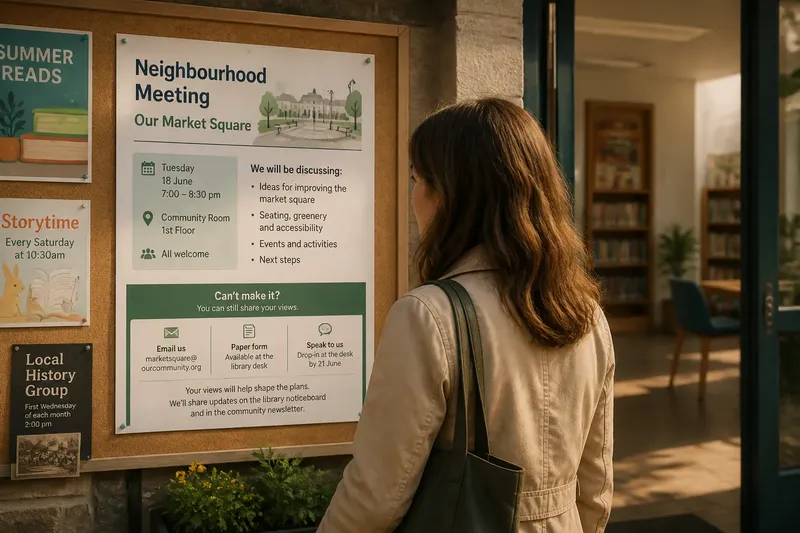
Write a plain arrival note with the venue name, entrance, room or meeting point, and a contact method for someone who gets lost. Include relevant access information and say whether the event is seated or outdoors. Do not promise facilities until the venue has confirmed them.
Keep an alternative format in mind if an essential feature changes. If a park plan depends on dry weather, confirm an indoor option or tell attendees how postponement decisions will be shared. If a room’s layout cannot support discussion, adjust the activity before sending invitations.
Which venue fits your gathering?
Is a town hall too formal for a community discussion?
Not necessarily. Ask whether the room allows circle or small-group seating, then give attendees clear opportunities to speak.
Can a library host a lively event?
It may, if a suitable room can accommodate the noise and movement. Ask staff about room limits and nearby users before settling on activities.
What if a park gathering depends on good weather?
Decide in advance whether to move to a confirmed indoor space, postpone or cancel. Tell attendees when and how they will hear the decision.
Which venue works for people who may arrive late or leave early?
Look for a clear entrance, an easy-to-find meeting point and a format that does not interrupt the group when someone joins or leaves. A park may allow freer movement, while an indoor venue may provide clearer directions and shelter.
Choose the place that makes participation easier
When choosing a place for a community gathering, favour the venue that lets people arrive, understand the format and take part with little friction. A town hall, library or park can each serve a public purpose, but each suits different activities and patterns of attention. Before confirming the booking, check the route from the entrance to the place where people will join in; clear directions and an easy first move can help a newcomer feel able to take part.