Why a Public Bench Changes the Shape of a Square
See how a public bench shapes a square: follow its edges, sightlines and nearby routes to understand where people pause, meet or keep moving.
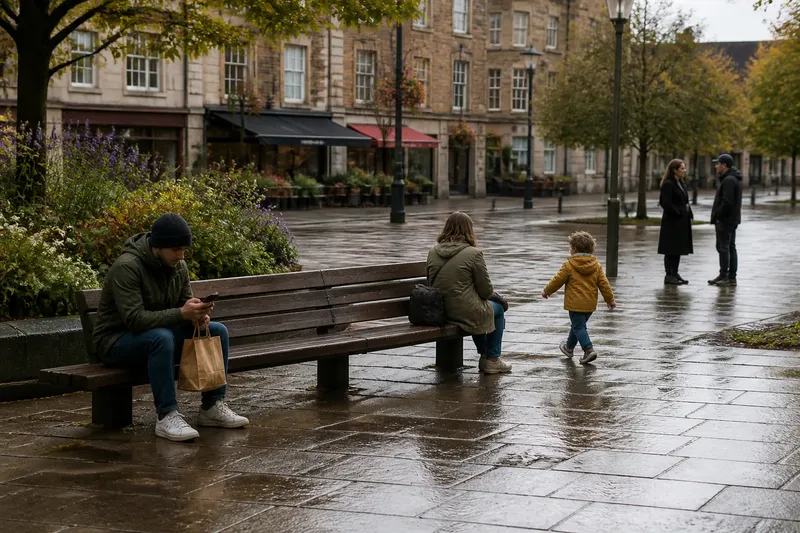
On a damp afternoon, someone carrying a paper bag stops beside a bench, checks a phone and sits at its far end. A parent settles nearby while a child circles the paving. Across the square, two people remain standing beside the path. The bench has not simply supplied somewhere to sit; it has changed where people can pause and how close they can be to one another.
To understand a square, look at its public benches as part of its layout. Their position, direction and relation to routes can make a corner feel sheltered, a path feel social or a wide open space feel easier to cross. A simple way to observe this is to notice where people stop, what they face and whether others can join without interrupting them.
A bench creates an edge within open space
A square often has few obvious boundaries. Paving may continue from the centre to shopfronts, a planting bed or a street crossing, leaving visitors to decide where to linger. A bench gives that open ground an edge: a place to rest that also marks a possible boundary between sitting and moving.
That edge can face several kinds of activity. A bench beside a flower bed may let people look into the square while keeping their backs to a planted border. One placed along a busy route can offer a short rest, though passing feet may make a longer stop less appealing. A seat turned towards an open centre gives a broad view; one tucked beside a wall can feel more contained.
Look at the relationship, not just the furniture. Is there room to approach from more than one direction? Does the seat sit against a useful edge, or stand exposed in the middle? Can a person seated there see a companion approaching?
A useful first note is simply: what does this seat make easy to face?
Public benches shape different kinds of pause
Not every pause is the same. Someone may sit briefly to tie a shoe, wait for a friend, eat lunch or watch activity. Each purpose calls for a different degree of comfort and connection. A seat beside a route can suit a short stop because it is easy to reach. A quieter bench near shade may invite people to stay longer.
Spacing also affects how a seat is used. A long bench with no division allows people to choose their distance, but an occupied row can feel difficult to join. Separate seats give visitors more choice over proximity, while a cluster can support conversation among people who arrive together. These arrangements do not dictate behaviour; they make some choices more available than others.
Notice what happens when someone is already seated. Do newcomers take another place, sit at the far end or remain standing? Does the arrangement allow a person to pause without seeming to claim a whole area? These small decisions reveal whether the bench supports individual rest, shared waiting or conversation.
Watch the gaps between people as carefully as the seats themselves.
Routes decide whether a bench feels easy to join
A bench is part of a network of approaches. Visitors may arrive from a crossing, a bus stop, a doorway or a path through the square. If the route to a seat cuts across a group or forces a tight turn, a passer-by may choose to keep walking. If the bench is visible and approachable, it can offer a natural stopping point.
Check whether a clear walking line passes in front of the seat. People should be able to move through without brushing seated visitors, and someone approaching should not have to step into a conversation to take a place. A bench set back from the main flow can provide room to pause; one placed too far from ordinary routes may be overlooked.
Also look for informal routes. Worn or frequently used paths across paving can show how people actually cross the square. A bench that blocks one of these lines may redirect movement; one beside it may create a place to stop without interrupting the crossing.
Say you arrive from a market street carrying a bag and notice a bench near a tree, set just beyond the main walking line. You might sit without blocking people heading to the crossing, while a friend can approach from the path and choose the next space. The observable sign is simple: arriving and leaving do not require anyone to squeeze past the seated pair.
What can a public bench tell you?
Why do people sit at one end of a bench?
An end seat can feel easier to enter and leave, especially if the rest of the bench is occupied. It may also offer a clearer view or more personal space, so note nearby routes and sightlines before deciding what the pattern means.
Does a bench facing a path encourage conversation?
It can make passers-by easier to notice, but a view of the path does not by itself make conversation likely. Check whether people turn towards one another, greet someone passing or remain focused on their own activity.
What does it mean if people stand beside a bench?
They may be waiting for a seat to open, keeping a conversation going or simply prefer to stand. Observe whether they use the bench as a meeting point or avoid sitting despite available space; the surrounding shade, noise and traffic may help explain the choice.
How can I observe a square without making assumptions?
Choose a place where you are not in anyone’s way and watch for a short, ordinary spell of activity. Record visible details—where people stop, which direction they face and how they approach—rather than guessing their reasons or identifying individuals.
Read the whole setting before judging the seat
A bench works alongside the square’s other features. Shade can make a seat more inviting during a bright spell; wind exposure can make the same spot less comfortable. A nearby tree, low wall or planter can create a sense of enclosure, while a fountain or active doorway may draw attention and conversation. Noise matters too: a seat beside a loud road may serve as a brief rest rather than a place to talk.
Access affects who can use the space. Notice the route from the pavement to the seat, the condition of the ground and whether the approach is clear. Look for a place to set down a bag or sit beside someone rather than across a gap. A square’s seating is more useful when its routes and nearby spaces allow people with different needs to take part in ordinary public life.
Keep observations descriptive. “Two people waited at the bench near the crossing” is something you can see. “They felt unwelcome” is an interpretation unless they say so. Separating the two leaves room for more than one explanation and makes your notes useful to neighbours, designers or local groups discussing how a square works.
Make a short observation that stays useful
Choose one bench and note its setting before watching activity. A few lines are enough to preserve details that memory can blur:
- Where the bench sits in relation to paths, entrances, planting and the square’s centre.
- Which way the seat faces and what someone sitting there can see.
- How people approach, leave and pass nearby.
- Whether people sit alone, sit together, wait standing or keep moving.
- What nearby shade, wind, noise or activity might affect the choice to pause.
- Where a person can sit without blocking the route or having to join a group.
Return at another ordinary time before drawing a broad conclusion. A quiet spell may reflect weather, a closed shop or a passing event rather than the bench’s arrangement. Comparing the same place under different conditions helps distinguish a recurring pattern from a moment.
For a quick reading of a public bench, follow its edge, sightline and approach, then describe what people visibly do. Those three details show how a small piece of furniture can give a square more than one pace: a route for passing through, a place for a brief rest and a possible setting for company.